December 3, 2025
The Rosetta Stone: How Hieroglyphs Were Finally Deciphered
The remarkable story of how a stone slab discovered by Napoleon's soldiers in 1799 became the key to unlocking ancient Egypt's secrets, and the brilliant scholars who raced to crack the code.
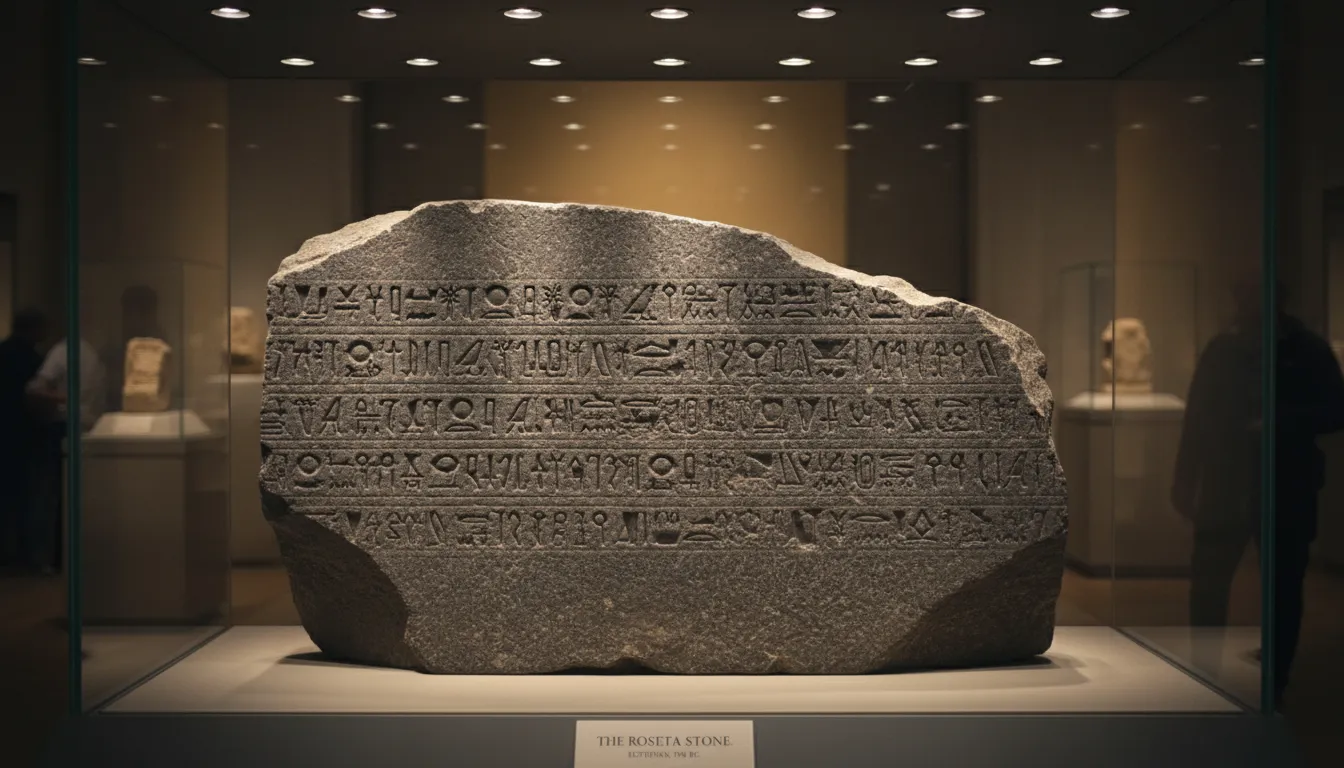
For over a thousand years, Egyptian hieroglyphs were a complete mystery. Scholars gazed upon the beautiful symbols adorning temples and tombs, knowing they held the secrets of one of humanity's greatest civilizations — yet unable to read a single word. Then, in 1799, a chance discovery by Napoleon's soldiers changed everything.
The Rosetta Stone is arguably the most famous archaeological artifact in history, and for good reason. This unassuming slab of granodiorite became the key that unlocked ancient Egypt's voice, allowing us to finally understand the stories written on pyramid walls thousands of years ago.
The Discovery
In July 1799, during Napoleon Bonaparte's Egyptian campaign, French soldiers were strengthening the defenses of Fort Julien near the town of Rashid (known to Europeans as Rosetta) in the Nile Delta. While digging foundations, a soldier named Pierre-François Bouchard noticed a large stone slab with inscriptions in three different scripts.
The stone was immediately recognized as significant. It contained what appeared to be the same text written three times: once in hieroglyphs at the top, once in an unknown script in the middle (later identified as Demotic), and once in Ancient Greek at the bottom. Since scholars could read Greek, they finally had a potential key to understanding the mysterious hieroglyphs.
The Rosetta Stone is not complete — the top portion containing most of the hieroglyphic text is missing. Despite this, it provided enough information to crack the code of ancient Egyptian writing.
What Does the Stone Say?
The content of the Rosetta Stone is surprisingly mundane for such a famous artifact. It's a priestly decree issued in 196 BCE during the reign of Ptolemy V Epiphanes, a Macedonian Greek pharaoh. The decree essentially praises the young king for his generosity to temples and grants tax exemptions to priests.
The text was written in three scripts to ensure it could be read by different audiences: hieroglyphs for the traditional religious context, Demotic for everyday Egyptian readers, and Greek for the ruling administration. This multilingual approach, common in Ptolemaic Egypt, inadvertently created the perfect decoder ring for future scholars.
The Race to Decipher
After the British defeated Napoleon's forces in Egypt, the Rosetta Stone was transferred to British possession under the Treaty of Alexandria in 1801. It arrived at the British Museum in 1802, where it remains today — one of the most visited objects in the collection.
The race to decipher hieroglyphs became an intellectual competition between two brilliant minds: the English polymath Thomas Young and the French scholar Jean-François Champollion.
Thomas Young's Breakthrough
Thomas Young made crucial early progress. By 1814, he had correctly identified that the oval shapes (called cartouches) contained royal names, and he successfully matched some hieroglyphs to their phonetic values. He recognized that hieroglyphs weren't purely symbolic but had phonetic elements — a revolutionary insight.
However, Young believed that only foreign names were written phonetically, while Egyptian words were purely ideographic. This assumption limited his progress and left the door open for Champollion's breakthrough.
Champollion Cracks the Code
Jean-François Champollion had been obsessed with Egypt since childhood. Crucially, he had learned Coptic — the latest form of the ancient Egyptian language, still used in the Coptic Christian church. This knowledge of Coptic gave him an enormous advantage: he could recognize Egyptian words when he saw them phonetically spelled out.
On September 14, 1822, Champollion was examining copies of inscriptions from the temple of Abu Simbel. He recognized the name of Ramesses II spelled out phonetically in hieroglyphs. According to legend, he burst into his brother's office shouting "Je tiens l'affaire!" ("I've got it!") before fainting from excitement.
It is a complex system, a script that is at once figurative, symbolic, and phonetic, in one and the same text, in one and the same sentence, and, I might almost say, in one and the same word. - Jean-François Champollion, describing the hieroglyphic system
The Key Insights
Champollion's genius was recognizing that the hieroglyphic system was more sophisticated than anyone had imagined. His key insights included:
- Hieroglyphs combined phonetic signs (representing sounds) with logograms (representing words or concepts)
- The same symbol could function differently depending on context
- Egyptian was related to Coptic, allowing him to identify vocabulary and grammar
- Foreign names provided a starting point, but the system applied to all Egyptian words
Champollion published his findings in his famous Lettre à M. Dacier in 1822, and spent the rest of his short life (he died in 1832 at age 41) expanding our understanding of ancient Egyptian language and civilization.
Legacy and Impact
The decipherment of hieroglyphs opened a floodgate of knowledge. Suddenly, the thousands of inscriptions covering Egypt's monuments could be read. We could hear the voices of pharaohs, priests, and ordinary Egyptians across millennia. History books had to be rewritten as primary sources became available.
Today, Egyptology is a thriving field, and new discoveries continue to reshape our understanding of ancient Egypt. Modern technology — including the kind of projects built at ArchaeoHack — is helping scholars read damaged texts, analyze patterns in hieroglyphic usage, and make ancient Egyptian accessible to new audiences.
Timeline: The Decipherment of Hieroglyphs
July 1799
French soldiers discover the Rosetta Stone near Rashid, Egypt
1801
British acquire the stone after defeating Napoleon's forces
1802
Rosetta Stone arrives at the British Museum
1814
Thomas Young identifies cartouches and some phonetic values
September 14, 1822
Champollion's breakthrough — recognizes Ramesses' name
September 27, 1822
Champollion presents his findings to the Académie des Inscriptions
1824
Champollion publishes Précis du système hiéroglyphique
See It for Yourself
The Rosetta Stone remains on display at the British Museum in London, where it has been since 1802 (except during World War I, when it was moved underground for protection). It's one of the most popular exhibits in the museum, drawing millions of visitors each year who come to see the artifact that gave us back ancient Egypt's voice.
At ArchaeoHack, you'll have the opportunity to work with the same writing system that Champollion spent his life studying — but with 21st-century tools. What mysteries might you help unlock?
This is part of our series exploring Egyptian hieroglyphs and the history of Egyptology. Check out our Introduction to Hieroglyphs to learn the basics of this ancient writing system.