December 3, 2025
Introduction to Egyptian Hieroglyphs: The Sacred Symbols That Shaped History
Discover the fascinating world of Egyptian hieroglyphs — the ancient writing system that has captivated scholars and enthusiasts for millennia. Learn about the different types of hieroglyphic characters and their meanings.
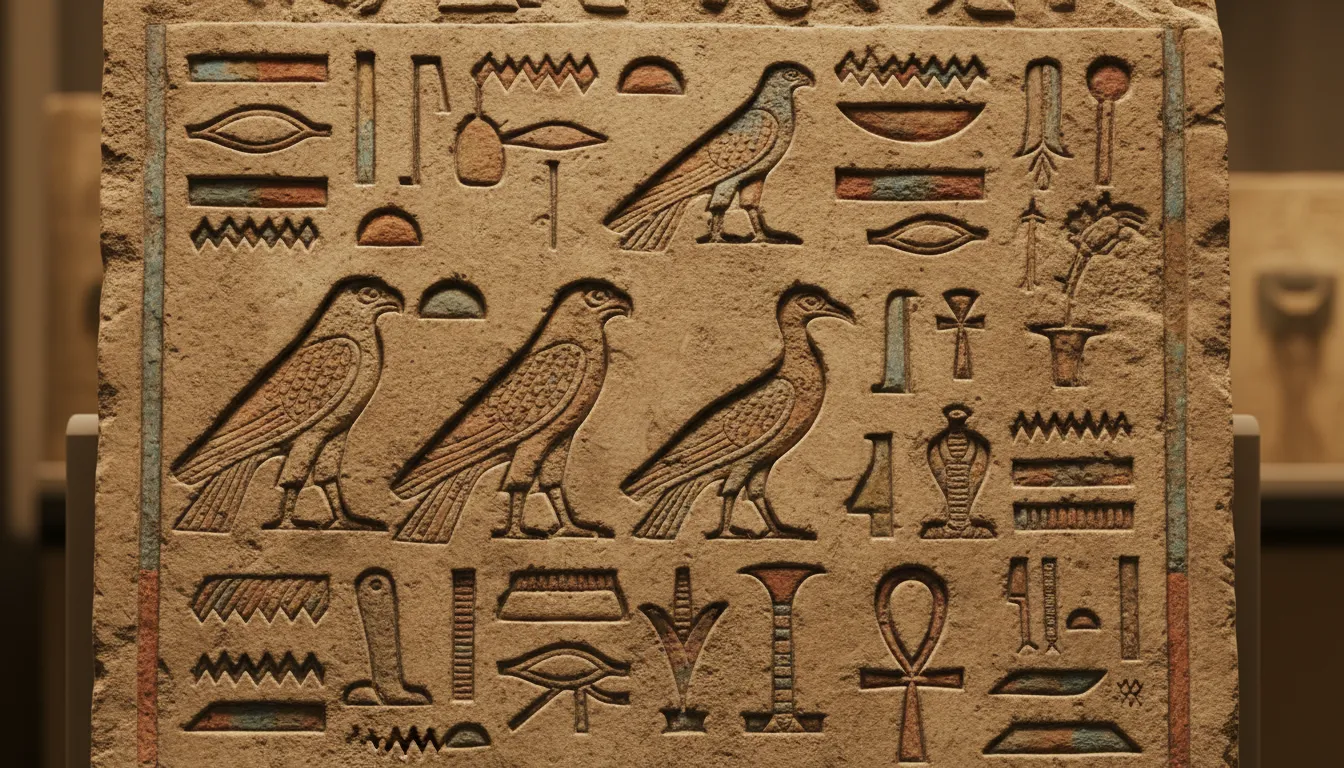
For over three millennia, the ancient Egyptians recorded their history, beliefs, and daily life using one of the most visually stunning writing systems ever created: hieroglyphs. The word itself comes from the Greek hieroglyphikos, meaning "sacred carving" — and sacred they were indeed, adorning the walls of temples, tombs, and monuments throughout Egypt.
Whether you're preparing for ArchaeoHack or simply curious about ancient cultures, understanding hieroglyphs opens a window into one of humanity's greatest civilizations. Let's explore how this remarkable writing system works.
The Three Types of Hieroglyphic Characters
One of the biggest misconceptions about hieroglyphs is that each symbol represents a single word or idea. In reality, the Egyptian writing system is far more sophisticated, combining three distinct types of characters that work together to convey meaning.
1. Logograms (Word Signs)
Logograms are symbols that represent entire words or concepts. When you see a picture of the sun (☉), it can directly mean "sun" or the sun god Ra. A logogram is often followed by a single vertical stroke to indicate it should be read as a complete word rather than a sound.
Examples of common logograms include symbols for gods, animals, body parts, and natural elements. The beauty of logograms is their visual directness — you can often guess the meaning just by looking at the picture.
2. Phonograms (Sound Signs)
Phonograms represent sounds rather than meanings — similar to letters in our alphabet. However, Egyptian phonograms are more complex, representing one, two, or even three consonants at a time. Ancient Egyptian writing typically omitted vowels, which is why we're often uncertain about exact pronunciations.
For instance, the owl hieroglyph (𓅓) represents the sound "m," while the mouth symbol (𓂋) represents "r." These phonetic signs allowed Egyptians to spell out words that couldn't be easily depicted as pictures.
3. Determinatives (Meaning Signs)
Determinatives are silent symbols placed at the end of words to clarify meaning. They aren't pronounced but help readers understand the category or context of a word. Think of them as visual context clues.
For example, words related to walking or movement might end with a pair of walking legs (𓂻), while words about writing or abstract concepts might end with a papyrus scroll (𓏛). This was especially useful since many Egyptian words sounded alike but had different meanings.
Common Hieroglyphic Characters Reference
Explore some frequently used hieroglyphs and their meanings. Click on each category to expand.
How Hieroglyphs Were Deciphered
For centuries after the fall of ancient Egypt, hieroglyphs remained a mystery. It wasn't until 1799, when Napoleon's soldiers discovered the Rosetta Stone in Egypt, that scholars had the key to unlock this ancient script.
The Rosetta Stone contained the same text written in three scripts: hieroglyphic, Demotic (a later Egyptian script), and Ancient Greek. French scholar Jean-François Champollion used his knowledge of Greek and Coptic (a descendant of the ancient Egyptian language) to finally crack the code in 1822.
I've got it! I've found the key to the hieroglyphs! - Jean-François Champollion, upon his breakthrough in 1822
Reading Direction: Following the Figures
Unlike English, which always reads left to right, hieroglyphs could be written in multiple directions: left to right, right to left, or even top to bottom. So how do you know which way to read?
The secret lies in the direction the figures face. Human and animal hieroglyphs always face toward the beginning of the text. If a bird or person faces left, read from left to right. If they face right, read right to left. It's like the characters are looking at the start of the sentence!
The ancient Egyptians had over 700 hieroglyphic symbols, but only about 100 were commonly used in everyday writing. By the Greco-Roman period, this had expanded to several thousand!
Hieroglyphs in the Modern World
Today, hieroglyphs continue to captivate scholars, artists, and technologists alike. In 2016, Unicode officially added Egyptian hieroglyphs to its standard, meaning you can now type ancient Egyptian characters on modern computers and smartphones. This intersection of ancient and modern is exactly what we explore at ArchaeoHack!
Machine learning and AI are now being applied to help decipher damaged or incomplete hieroglyphic texts, while augmented reality apps allow museum visitors to see translations overlaid on ancient artifacts. The possibilities for innovation are endless.
Start Your Journey at ArchaeoHack
Understanding hieroglyphs is just the beginning. At ArchaeoHack, you'll have the opportunity to work with these ancient symbols in innovative ways — whether building translation tools, creating educational games, designing visualization systems, or developing something entirely new.
No prior knowledge of Egyptian hieroglyphs is required to participate. Our expert-led workshops will give you the foundation you need to create something amazing. The question is: what will you build?
This is the first in our series of articles exploring the fascinating world of ancient Egyptian writing. Stay tuned for more deep dives into specific hieroglyphs, famous inscriptions, and the technology being used to study them today.